

Features
Connecticut Essex Village 1843 Greek Revival Gets Period-Appropriate Facelift
Over nearly a decade, Robert Orr Architects gave a historic Connecticut property a major overhaul, now celebrating once again its stately presence on Main Street.
It was supposed to be a really small project.
The new owners of a Greek Revival residence in Connecticut’s historic Essex Village didn’t like the color of the floors and thought the period-style doors were too thin. Architect Robert Orr, whose eponymous firm is based in New Haven, conducted a cursory consultation, made some suggestions, and figured that was that.
Soon, however, the owners called upon him to do another “little” project, and another and another, in what turned out to be an eight-year-long process of renovating the house and the grounds, which has been recognized with a pair of design awards.
There was no master plan, per se: everything evolved over time. “This isn’t typically how we do projects,” Orr says, adding that, in this case, “when one project ended, another started.”
Carol Orr—Orr’s wife, landscape partner, and winner of the project’s Traditional Building Palladio Awards and an Institute of Classical Architecture & Art Bulfinch Award—designed the gardens that weave throughout the quarter-acre lot, meandering zigzag fashion over 100 yards to the Connecticut River.
“To overcome the property’s cramped complexities, we turned liabilities into assets through a choreographic approach,” he says. “Instead of [ending up with] dead ends and inconvenience, we sequenced punctuated dance movements to flow in and out of three buildings and seven gardens.”
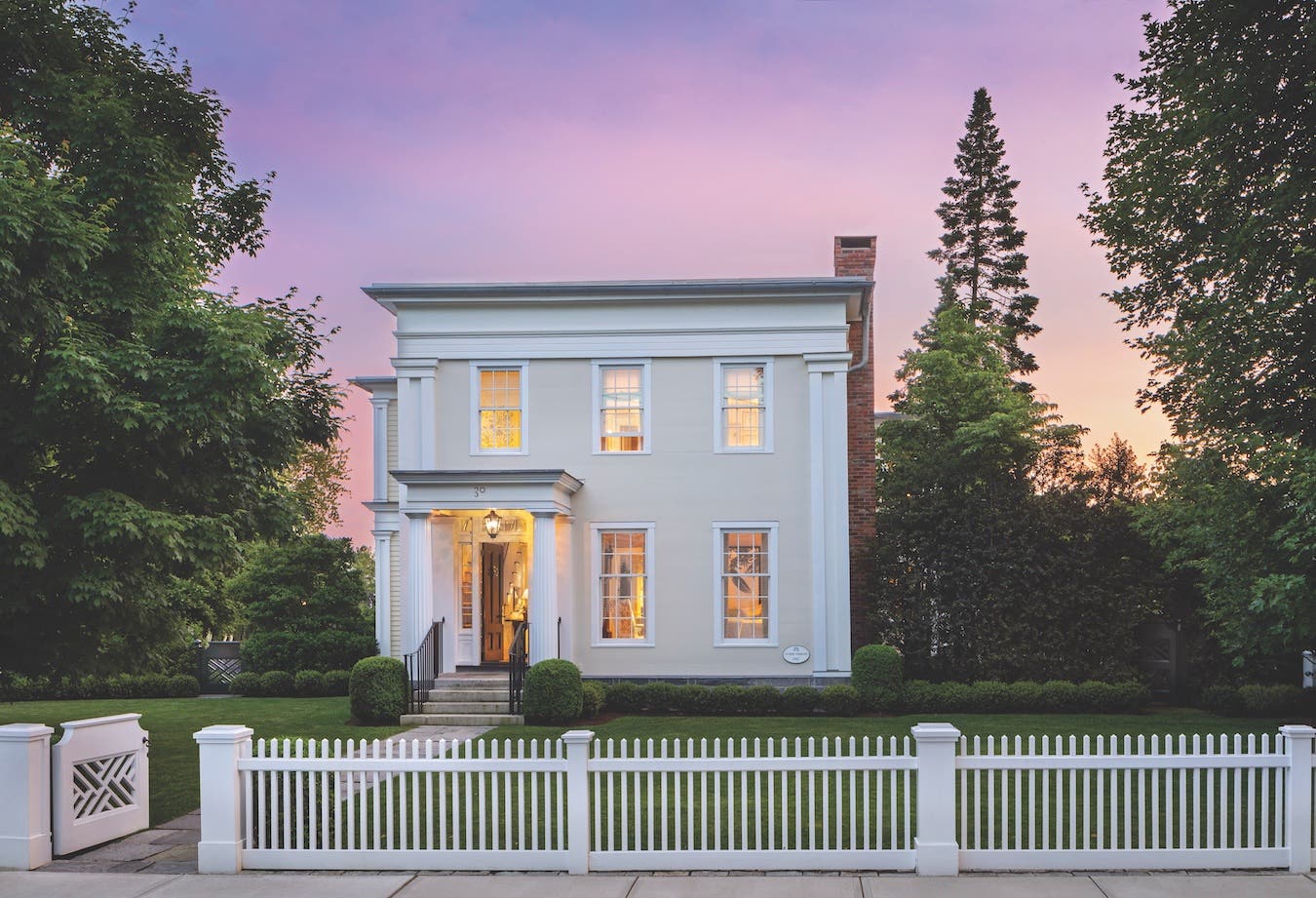
Because the house, which is set behind a white picket fence and a neatly trimmed hedge, had been gut renovated by six different owners over the previous decade, little of the original structural and architectural details of 1843 remained.
Noting that the house was buried by time, Orr says that “nothing was left—even the fireplace mantels had been ripped out. And the trim was gone.”
Read more: A Greek Revival Home with Southern Charm
All that was known about the property was that it was thought to have been built by one Captain Ezra Polk, who is credited with bringing the Greek Revival style to the village while establishing a trade route between New England and Mobile, Alabama, where he would have seen many examples of this architectural style.
“Instead of relying upon sparse extant material, we decided to imagine ourselves as a nineteenth-century Mobile builder, still alive today, a character with his head accustomed to twenty-first-century conveniences but with his feet planted firmly in the nineteenth century,” Orr says.
With this fanciful fictional figure as his guide, Orr, along with senior associate Jared Sedam, took the house back to its old bones, stripping the numerous inappropriate renovations and reskinning the façade with flat-wood planks to resemble masonry stucco.
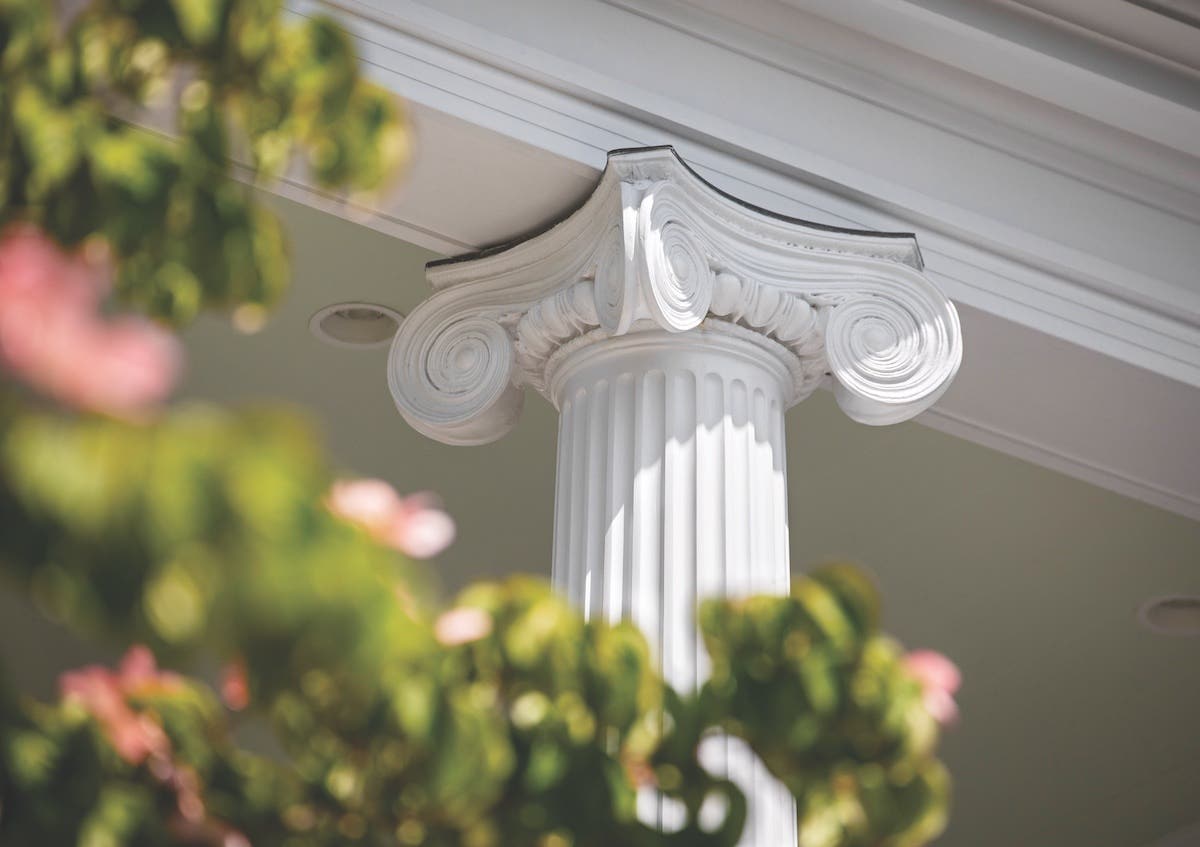
They added eye-catching period-style character, including tall exterior columns, an entry portico with columns, iron railings and millwork for the entablature, and a loggia that looks out over the water.
In addition, they renovated the garage, turning it into a classic-style carriage house crowned by a cupola, with an upper-floor apartment for guests, and transformed a box-like structure into a garden folly “sum- merhouse” with French doors that open to a view of the Connecticut River.
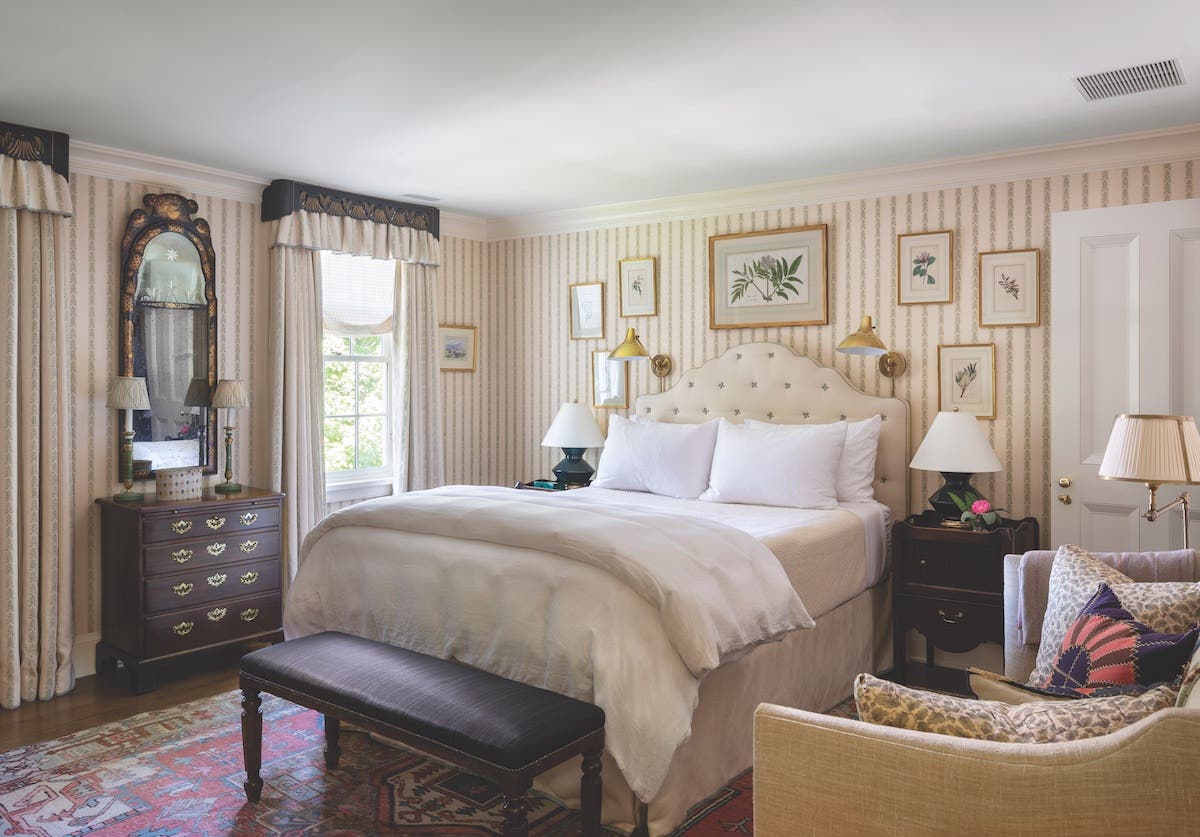
Inside the main residence, they created a large kitchen. The owners love to cook and entertain and have decorated the house with their extensive collection of English antiques, which includes wooden cabinetry with small panels on the doors; Orr says “it is like walking into a great piece of furniture.”
Carol Orr envisioned the estate’s buildings as a pair of aligned spines and planted the garden rooms—an entry-court garden, a rose garden, a tapis vert (lawn) garden, a trompe l’oeil garden, an old-fashioned garden, a secret garden, and three other gardens—around them.
“With so many things happening on such a small property, it would be easy to have a disjointed feel,” she says. “Through a palette of plant material and hardscape elements, the pieces flow naturally together.”
The project, her husband says, “was a unique collaboration that evolved among client, architect, landscaper, and the ghost of the original builder, to form a consensus that designed with a single voice.”
He credits “the gifted hands of skilled artisans”—the joinery/millwork/wood carvers, Parisian stone carvers, blacksmiths, and muralist—not only with creating nineteenth-century attention to detail but also with expertly concealing twenty-first-century conveniences, including connectivity, entertainment, appliances, lighting, plumbing, and environmental systems.
The pinewood floors that initiated the project were indeed recolored and enhanced with decorative inlays, but the doors, already appropriate to the Greek Revival style, remain unchanged.
This Main Street property, highly visible in what Orr calls the “prettiest village in America,” Essex Village, Connecticut, is one of the stars of the annual holiday tour. “All the main projects are done,” Orr says with a tinge of regret in his voice. “But the owner might get inspired by something new.”
And he hopes so, because “it’s been eight delightful years so far.”

Supplier of solid-brass vintage door hardware: more than 20 door-set patterns with coordinating cabinet hardware & accessories; for new construction & historic renovation projects; complete list of North American dealers online.